
- Why Your Financial Plan Needs to Adapt
- Assessing Your Current Financial Position and Life Transitions
- Financial Plan Review Checklist: What to Evaluate
- Superannuation Contributions When Your Circumstances Change
Last Updated: August 16, 2026
Why Your Financial Plan Needs to Adapt
As a financial planner, one thing that we can guarantee you in life is that things will change. Your financial plan should therefore be flexible enough to change with it. The strategy that was right for you three years ago may no longer be appropriate when your income changes, your family circumstances evolve, you buy or sell a property, change careers or experience an unexpected life event.
A financial plan should not simply be prepared, filed away and forgotten. Regular reviews help ensure your strategy remains relevant and continues to reflect your goals, circumstances and priorities. While we recommend reviewing your plan at least annually, a good financial planner should also be available to help you navigate significant changes when they occur. Your financial plan should be a living strategy that evolves with you, rather than a document that sits on a shelf.
Assessing Your Current Financial Position and Life Transitions
Before you can adapt your financial plan effectively, you need an honest picture of where you stand right now. Document your current income, expenses, assets, and liabilities. This isn’t a one-time exercise; it’s the foundation for recognising what’s actually changed. You will need to do this at least every year for your Review.
Life transitions are the catalyst for most plan adaptations. A career change, relationship milestone, health event, or shift in family structure all signal that your original assumptions may no longer hold. A partner returning to work, a child entering school, or a parent requiring care fundamentally alters your financial picture and affects your cash flow, risk tolerance, and priorities. Understanding how these changes flow through your entire financial picture, from debt obligations to insurance needs, is where Cashflow specialists can provide clarity, helping you see exactly where money moves and where adjustments are needed.

Financial Plan Review Checklist: What to Evaluate
A structured approach to reviewing your plan ensures nothing gets overlooked. Use this checklist when you adapt your financial plan:
Income and Employment
- Has your primary income changed (increase, decrease, or structure shift)? Do you have new income sources, or have existing ones disappeared? Has your employment status shifted?
Expenses and Commitments
- Update your budget/cashflow. Have your monthly or annual expenses increased or decreased?
- Are there new financial commitments or have existing ones reduced?
Superannuation and Retirement
- Are your superannuation contributions still aligned with your retirement goals?
- Has your retirement timeline shifted?
Debt and Liabilities
- What’s your current debt position? Have interest rates or terms changed?
- When will you pay off your mortgage/debts? Do you have capacity to accelerate debt repayment?
Assets and Investments
- What’s your current asset allocation? Do your investments still match your risk tolerance and time horizon? Your adviser will work through this with you.
Personal Insurance and Protection
- Is your life, TPD, income protection and Trauma sums insured still relevent considering your current circumstances.
- Are your policies still competatively priced?
Tax Position
- Have changes to your income created new tax planning opportunities?.
- Have you got any further capacity to make contributions to super to reduce your tax?
Veyron Wealth Group helps clients work through this checklist systematically, ensuring that when you adapt your financial plan, every element is considered in context.
Superannuation Contributions When Your Circumstances Change
Superannuation is an important part of your long-term financial strategy, but your circumstances can change over time. A change in income, employment, family circumstances or your intended retirement date may mean your existing superannuation strategy needs to be reviewed.
For most employees, your employer is required to make Superannuation Guarantee (SG) contributions on your behalf. If your income changes, the amount of SG paid into your super will generally change accordingly. If you take a career break or become unemployed, employer contributions will generally stop during that period.
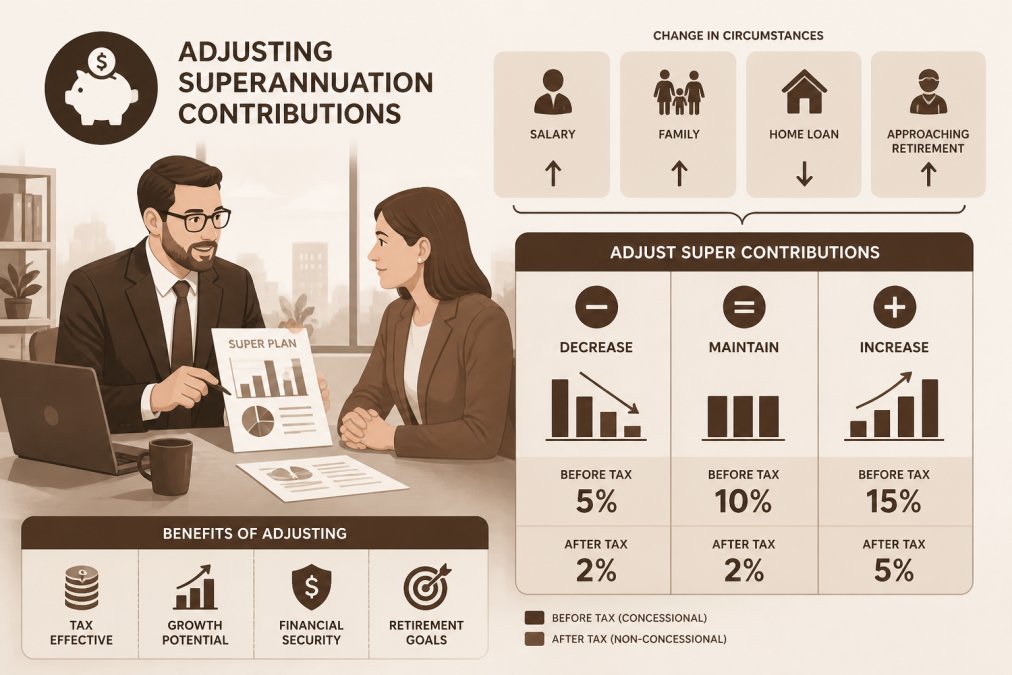
Changes in your circumstances may also provide an opportunity to consider additional voluntary contributions to superannuation. Depending on your income and circumstances, this could include concessional contributions, such as salary sacrifice or personal deductible contributions, or non-concessional contributions from your after-tax savings. Contribution caps and eligibility rules apply, so these strategies need to be considered carefully.
Your retirement timeframe should also be taken into account. If you decide to retire earlier or later than originally planned, it may be appropriate to review your contribution strategy, investment approach and the amount you need to accumulate to meet your retirement goals.
The key is to ensure your superannuation strategy continues to work alongside your broader financial plan. Regular reviews can help identify whether changes are required and whether you are making the most of the opportunities available within the superannuation rules.
Veyron Wealth Group can help you review your superannuation strategy as your circumstances change and determine whether adjustments are appropriate as part of your broader financial plan.
Get a Free Consultation to discuss how your current plan is tracking and what adaptations might benefit your situation.
General Disclaimer
The information contained in this article is general in nature and provided for information purposes only. Any references to investment returns, performance, asset classes or market conditions are not intended to constitute personal financial advice. While reasonable care has been taken in preparing this material, no liability is accepted by Veyron Wealth Group or Count, its related entities, agents or employees for any loss arising from reliance on this information. Past performance is not a reliable indicator of future performance and investment returns are not guaranteed. Clients need to assess the appropriateness of any information in light of their individual circumstances, consider the relevant Product Disclosure Statements (PDS) and other disclosure documents, and obtain personal financial advice prior to making any investment decision.
Frequently Asked Questions
When should I review my financial plan?
Review your financial plan annually as a minimum, or whenever a significant life event occurs—such as a change in income, family structure, or employment. Major shifts in market conditions or your personal priorities also warrant a review. A tailored financial advice professional can help you identify whether your current strategy still aligns with your core values and long-term objectives.
What triggers a need to update my Statement of Advice (SoA)?
Your SoA (Statement of Advice) should be updated when your financial circumstances, goals, or risk tolerance materially change. Common triggers include significant income shifts, major life transitions like marriage or children, substantial changes in assets or liabilities, or shifts in your long-term objectives. Regular reviews ensure your SoA remains current and reflects advice appropriate to your situation.
Can I adjust my superannuation contributions mid-year?
Yes, you can adjust your superannuation contributions during the financial year. Changes to salary sacrifice arrangements can typically be made with your employer. However, tax implications and contribution caps apply, so it’s important to understand how adjustments affect your overall tax position and retirement strategy. A financial adviser can guide you through the process and help maximise the benefit of any changes.
