
Table of Contents
- Starting Your Estate Planning Checklist
- Step 1: Document Your Assets and Liabilities
- Step 2: Prepare Your Will and Appoint an Executor
- Step 3: Set Up Superannuation Death Benefit Nomination and Beneficiary Arrangements
Last Updated: August 17, 2026
Starting Your Estate Planning Checklist
An estate planning checklist for Australian families protects your family’s financial future and ensures your wishes are carried out after you pass away. Without a structured approach, assets can be distributed incorrectly, tax obligations may be overlooked, and family disputes can arise.
Before you begin, gather key information about your situation: superannuation accounts, investment holdings, property ownership, outstanding debts, and any dependents who rely on your income. Veyron Wealth Group recommends starting with a clear picture of what you own and what you owe. This foundational step prevents costly mistakes and ensures your estate planning checklist addresses your family’s actual circumstances.
Consider involving relevant people early in the process. Your spouse, adult children, or trusted advisors may need to understand your intentions, though the actual planning documents should reflect only your decisions.
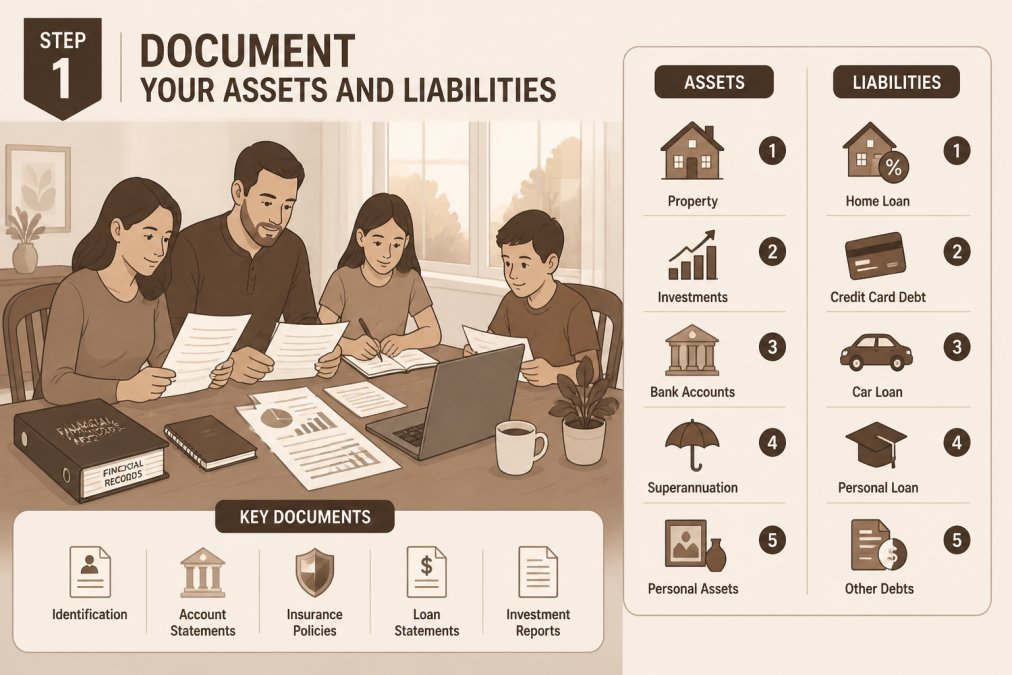
Step 1: Prepare an Inventory of Your Assets and Liabilities
Your first step in preparing for your Will and estate planning is to create a complete inventory of everything you own and owe. This forms the backbone of your estate planning and helps determine the value of your estate and how your assets may ultimately pass to your beneficiaries.
Superannuation
Start by listing each superannuation account, including the fund, account balance and the type of death benefit nomination currently in place, such as a binding or non-binding nomination.
It is important to understand that superannuation does not automatically form part of your estate and can, in certain circumstances, pass directly to your beneficiaries without going through your Will. This is generally achieved through a valid death benefit nomination.
However, superannuation law restricts who can receive a superannuation death benefit directly from a super fund. If the person you wish to nominate does not qualify as a superannuation beneficiary, they may not be able to receive the benefit directly from the fund. In these circumstances, you can generally nominate your legal personal representative (your estate) to receive the superannuation death benefit, with the benefit then being dealt with under your Will.
For example, adult children who are not financially dependent on you may not qualify to receive your superannuation death benefit directly. In this situation, consideration may be given to directing the superannuation to your estate, so that it can then be distributed in accordance with your Will.
It is therefore important to review your superannuation death benefit nominations as part of your estate planning and ensure they are consistent with your overall wishes.
If you have a Self Managed Super Fund (SMSF), ensure your SMSF documentation is current and that your death benefit strategy and any binding death benefit arrangements are properly documented.
Step 2: Prepare Your Will and Appoint an Executor
Your Will is an important legal document that sets out how the assets that form part of your estate are to be distributed after your death. If you die without a valid Will, your estate will generally be distributed according to the intestacy laws that apply in your state or territory. This may result in your assets being distributed differently from how you would have wished.
When preparing your Will, you should appoint an executor — the person or organisation responsible for administering your estate. The executor will generally be responsible for identifying and collecting estate assets, dealing with liabilities and expenses, and distributing the remaining estate in accordance with your Will. Choose someone you trust who is organised, capable and willing to take on this responsibility.
Your Will should clearly identify your intended beneficiaries and explain how you want the assets forming part of your estate to be distributed.
If you have children under 18, your Will can appoint a testamentary guardian to care for them and make decisions about their long-term welfare if the circumstances arise in which the appointment takes effect. In Queensland, the operation of a testamentary guardian appointment can depend on whether another parent or guardian survives you.
You may also establish a testamentary trust through your Will, allowing assets inherited by children or other beneficiaries to be managed on their behalf rather than transferred to them outright. This can be particularly valuable where beneficiaries are minors, are not yet financially mature, or where there are other circumstances that warrant greater control over how an inheritance is managed.
It is also important to consider whether any of your children may be unable to manage an inheritance independently due to mental health issues, addiction, disability or other circumstances affecting their capacity. A carefully structured Will can help protect their inheritance while still providing for their long-term wellbeing. These can be difficult and sensitive matters to consider, but thoughtful estate planning can provide reassurance that your wishes are respected and your children are appropriately supported. We recommend discussing your individual circumstances with an experienced estate planning solicitor who can advise on the most appropriate arrangements..
Consider Powers of Attorney. An Enduring Power of Attorney allows you to appoint a trusted person to make financial and personal decisions on your behalf if you lose the capacity to make those decisions yourself. An Enduring Power of Attorney can provide important protection and ensure your affairs continue to be managed according to your wishes. A Medical Power of Attorney allows you to nominate someone to make healthcare and medical decisions on your behalf if you are unable to make or communicate those decisions yourself. We recommend seeking advice from an estate planning solicitor to ensure these documents are properly prepared and reflect your wishes.
If you already have a Will and need to make changes, your solicitor can advise whether a codicil — a formal amendment to an existing Will — is appropriate, or whether it would be preferable to prepare a new Will. Any changes should be properly executed to ensure they are legally effective.
Step 3: Set Up Superannuation Death Benefit Nomination and Beneficiary Arrangements
Your Will does not necessarily control your superannuation. Superannuation death benefits can pass directly from the super fund to an eligible beneficiary or, depending on the nomination and circumstances, to your legal personal representative/estateYour superannuation death benefit nomination determines who receives your super balance when you die.
A binding death benefit nomination (BDBN) is a formal written instruction to your super fund trustee about who should receive your benefit. It’s legally binding on the trustee. A non-binding nomination is a request the trustee can choose to decline if they believe it’s inappropriate.
Many financial advisors recommend binding nominations because they give you certainty about where your super goes. However, binding nominations can be inflexible if circumstances change. Some funds offer reversionary beneficiaries, automatically nominated beneficiaries who receive the income stream from your super if you pass away whilst still drawing a pension.
Check whether your super fund requires your beneficiary nomination to be witnessed or signed in a particular way. Different funds have different processes, and a nomination completed incorrectly may not be valid.
Superannuation death benefits paid to a spouse or dependent child are generally tax-free. Benefits paid to a non-dependent adult may be subject to tax. Understanding these rules helps you make informed decisions about who should receive your super. Our Superannuation specialists can help you navigate these complexities and ensure your nominations align with your overall estate plan.
Review your nomination regularly, particularly after significant life events like marriage, divorce, or the birth of children. Outdated nominations are a common source of family disputes and unintended outcomes.
According to the Australian Taxation Office guidance on superannuation death benefits, proper nomination ensures your super passes to your chosen beneficiaries efficiently and with minimal tax impact.
Professional Estate Planning Advice
Estate planning is more than simply preparing a Will. Your Will should be considered alongside your superannuation, ownership of assets, family circumstances, tax position and your broader financial plan to help ensure your wishes can be implemented effectively.
As financial planners, Veyron Wealth Group cannot draft or prepare Wills or provide legal advice. However, we can help you identify the estate-planning issues that may need to be considered as part of your overall financial plan and, where appropriate, refer you to experienced estate-planning solicitors who can provide the necessary legal advice and prepare your Will and other legal documents.
We can then work with you and your solicitor, where appropriate, to ensure your financial arrangements — including superannuation nominations, ownership structures and other assets — are considered alongside your estate-planning objectives.
Estate planning should also be reviewed when your circumstances change, such as marriage, separation or divorce, the birth of children or grandchildren, significant changes in wealth, the purchase or sale of major assets, or the death of a beneficiary.
The objective is to ensure that your legal estate-planning documents and financial arrangements work together as effectively as possible.
General Disclaimer
The information contained in this article is general in nature and provided for information purposes only. Any references to investment returns, performance, asset classes or market conditions are not intended to constitute personal financial advice. While reasonable care has been taken in preparing this material, no liability is accepted by Veyron Wealth Group or Count, its related entities, agents or employees for any loss arising from reliance on this information. Past performance is not a reliable indicator of future performance and investment returns are not guaranteed. Clients need to assess the appropriateness of any information in light of their individual circumstances, consider the relevant Product Disclosure Statements (PDS) and other disclosure documents, and obtain personal financial advice prior to making any investment decision.
An estate planning checklist for Australian families isn’t a one-time task, it’s an ongoing part of responsible financial management. Your circumstances change, tax laws evolve, and family situations shift. Review your documents every few years or whenever a significant life event occurs.
Veyron Wealth Group’s approach to estate planning focuses on ensuring your wishes are clearly documented and legally sound. Proper estate planning protects your family from unnecessary stress, reduces the risk of disputes, and can minimise tax obligations.
Get a Free Consultation with Veyron Wealth Group to discuss how tailored financial advice can help you create an estate plan that reflects your family’s needs and protects your legacy.
Frequently Asked Questions
What documents do I need to include in my estate planning checklist?
Your estate planning checklist should include a valid Will, an Enduring Power of Attorney (EPA) for financial decisions, an advance care directive for healthcare preferences, superannuation death benefit nomination forms, and proof of asset ownership such as property titles and investment statements. If you have minor children, you’ll also need guardianship arrangements documented. Store originals in a secure location and keep copies with your executor and solicitor.
How does superannuation death benefit nomination fit into my estate plan?
Superannuation death benefit nominations are separate from your Will and allow you to direct how your superannuation balance is distributed after death. You can nominate beneficiaries directly, which bypasses probate and reaches your family faster. Review your nominations regularly—they don’t automatically transfer to new relationships or reflect life changes. Many people overlook this, leaving their super to be distributed according to their fund’s rules rather than their wishes.
What is the difference between an enduring power of attorney and an advance care directive?
An Enduring Power of Attorney (EPA) gives someone legal authority to manage your financial and legal matters if you become unable to do so. An advance care directive (also called a living will) records your healthcare and end-of-life preferences. Both are essential: the EPA protects your finances and property, while the advance care directive ensures your medical wishes are respected. They work together to cover your complete personal and financial wellbeing.
Why should I consider a testamentary trust in my Will?
A testamentary trust is created within your Will and takes effect after your death. It can protect assets for minor children, manage distributions for beneficiaries who may not be ready to handle large sums, provide tax benefits, and offer flexibility in how your estate is distributed. This is particularly valuable for blended families or where beneficiaries have special needs. A testamentary trust keeps control of assets within a structured framework rather than distributing everything outright.
